(1).png)
The FIFA World Cup is where football reputations become permanent. A player may score hundreds of club goals, but performing on the biggest international stage carries a different weight. Every opponent is prepared, every chance arrives under pressure, and one goal can decide whether a nation advances or goes home.
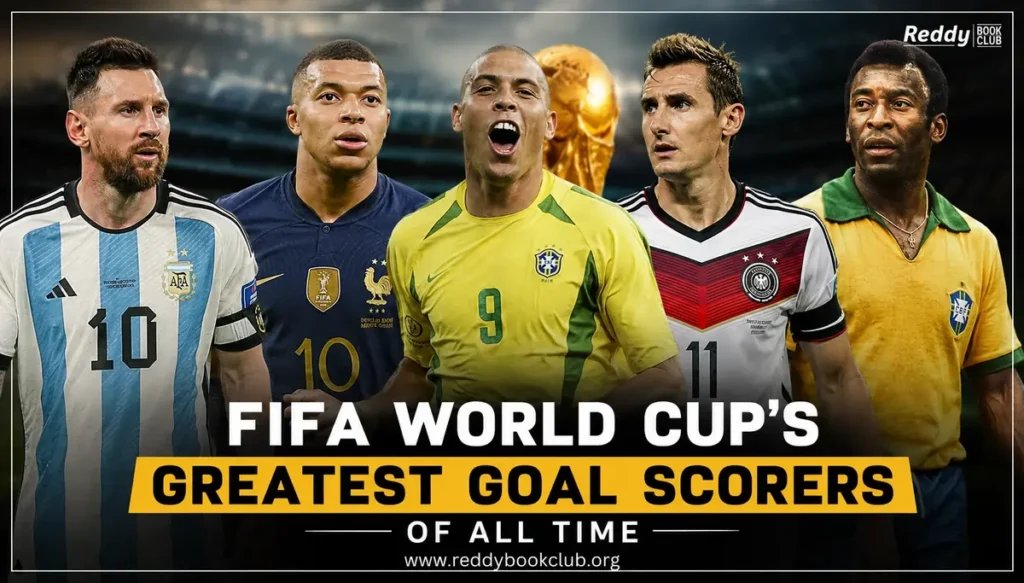
The all-time scoring race has changed dramatically during the 2026 tournament. Lionel Messi has moved to the top, while Kylian Mbappé is close behind. For readers following football history through Reddy Book Club, this guide explains the leading scorers, their defining moments and the records that shaped the competition.
The figures are updated through July 10, 2026. Since the tournament is still in progress, totals for active players may change.
Updated FIFA World Cup All-Time Scorers
| Rank | Player | Country | Goals |
|---|---|---|---|
| 1 | Lionel Messi | Argentina | 21 |
| 2 | Kylian Mbappé | France | 20 |
| 3 | Miroslav Klose | Germany | 16 |
| 4 | Ronaldo Nazário | Brazil | 15 |
| 5 | Gerd Müller | West Germany | 14 |
| 5 | Harry Kane | England | 14 |
| 7 | Just Fontaine | France | 13 |
| 8 | Pelé | Brazil | 12 |
| 9 | Sándor Kocsis | Hungary | 11 |
| 9 | Jürgen Klinsmann | Germany | 11 |
| 9 | Cristiano Ronaldo | Portugal | 11 |
Messi’s 21-goal total and Mbappé’s 20-goal mark were confirmed after the latest 2026 knockout matches. Mbappé reached the semi-finals one goal behind the record holder. Harry Kane has moved level with Gerd Müller on 14, while Cristiano Ronaldo ended his six-tournament World Cup journey with 11 goals.
Lionel Messi: The New Record Holder
Lionel Messi’s World Cup story developed over two decades. His early appearances showed moments of brilliance, but his defining campaign came in Qatar in 2022. He scored seven goals, delivered throughout the knockout rounds and led Argentina to the trophy after a memorable final against France.
The 2026 edition added another remarkable chapter. Messi scored eight goals across Argentina’s opening five appearances, moving beyond Miroslav Klose’s long-standing record. His ability to convert penalties, finish from open play and influence games from deeper areas makes the achievement more than a simple number.
Longevity has been essential to Messi’s success. He remained productive across six editions while adapting his role. The younger version attacked from wide positions, while the later version became a central creator, set-piece specialist and composed finisher.
Kylian Mbappé: One Goal from the Record
Kylian Mbappé has produced a scoring rate rarely seen at this level. He scored four times as France won the tournament in 2018, then added eight goals in 2022 and claimed the Golden Boot. His hat-trick in the 2022 final made him only the second player to score three times in a men’s World Cup final.
Mbappé has added eight more goals in 2026, taking his career total to 20. His strike against Morocco in the quarter-final moved him within one goal of Messi. He also reached 20 World Cup goals before turning 30 and achieved the total in only 20 appearances.
His acceleration, direct dribbling and calm finishing create problems for every defence. Sitting deep reduces the space behind but allows him to receive closer to goal. Defending higher gives him room to use his pace. With France still involved in the competition, the record could change again.
Miroslav Klose: The Standard for Consistency
Miroslav Klose held the scoring record for 12 years. The German striker scored 16 goals across the 2002, 2006, 2010 and 2014 editions. He never scored more than five in one tournament, yet his consistency kept him near the top every four years.
Klose began with a hat-trick against Saudi Arabia in 2002 and won the Golden Boot in 2006. His record-breaking 16th goal arrived against Brazil during Germany’s famous 7–1 semi-final victory in 2014. Germany later lifted the trophy, giving him the perfect ending to his World Cup career.
His strengths were simple but highly effective: movement, timing, aerial ability and an instinct for reaching the right area before defenders.
Ronaldo Nazário: Brazil’s Fearless Finisher
Ronaldo Nazário scored 15 goals in 19 World Cup matches. He was part of Brazil’s 1994 squad without playing, became a global star in 1998 and delivered his greatest tournament in 2002.
After serious knee injuries threatened his career, Ronaldo returned to score eight goals at the 2002 World Cup. Two came in the final against Germany, securing Brazil’s fifth title and completing one of football’s greatest comeback stories.
Ronaldo combined power, speed, balance and close control. He could beat defenders in open space, round goalkeepers or finish quickly inside a crowded penalty area.
Gerd Müller and Harry Kane: Level on 14
Gerd Müller needed only 13 matches to score 14 World Cup goals. Ten came in 1970, including back-to-back hat-tricks against Bulgaria and Peru. Four more followed in 1974, when West Germany became champions.
His winning goal against the Netherlands in the final remains one of German football’s most important moments. Müller rarely required much space or time. A loose ball, deflection or half-chance inside the area was often enough for him to score.
Harry Kane has now joined Müller on 14. The England captain won the 2018 Golden Boot with six goals, added two in 2022 and has continued scoring during the 2026 tournament. Kane is known for powerful finishing, reliable penalties, heading and his ability to drop into midfield to create chances for teammates.
Just Fontaine: The Single-Tournament Record
Just Fontaine scored all 13 of his World Cup goals in 1958. No player has matched that total in a single edition. He scored in every match France played, including four goals in the third-place playoff against West Germany.
Fontaine achieved the record in only six games. Modern players may receive more matches in an expanded format, but reaching 13 goals in one campaign still requires exceptional form, fitness and team performance.
Pelé: Twelve Goals and Three Titles
Pelé’s 12 goals tell only part of his World Cup story. He won the tournament with Brazil in 1958, 1962 and 1970, a record no other player has matched.
At 17, he scored six goals during the 1958 competition, including a hat-trick in the semi-final and two goals in the final. He later played a central role in Brazil’s celebrated 1970 team.
Pelé combined scoring with creativity, intelligent movement and an ability to improve the players around him. His impact cannot be measured only by his position on the scoring table.
Three Legendary Players on 11 Goals
Sándor Kocsis scored 11 goals in only five matches at the 1954 World Cup. Hungary reached the final, and his scoring rate remains one of the best in tournament history.
Jürgen Klinsmann spread his 11 goals across the 1990, 1994 and 1998 competitions. He was part of the West German team that won in 1990 and became known for delivering goals across three separate editions.
Cristiano Ronaldo finished with 11 goals after scoring three times in 2026. He also became the first player to score in six different World Cups. Although he never lifted the trophy, his longevity and ability to perform across changing generations secured a unique place in tournament history.
Career Scoring Record and Golden Boot Are Different
The all-time scoring record counts goals across every World Cup a player enters. The Golden Boot is awarded only to the leading scorer in one edition.
A footballer can therefore win the Golden Boot without approaching the career record. At the same time, a consistent scorer can climb the historical table without dominating one particular tournament.
When players finish level in the Golden Boot race, assists are used as the first tie-breaker. If they remain level, the player who needed fewer minutes receives the higher position.
Can the Record Change Again in 2026?
Yes. The competition is not finished, and Mbappé is only one goal behind Messi. Every additional knockout match gives him another opportunity to equal or pass the record.
The expanded 2026 format also provides teams reaching the final with more possible matches than in previous editions. This creates extra scoring opportunities, although the longer route demands greater fitness, squad depth and consistency.
One brilliant performance could completely change the order at the top. Messi may extend his advantage, Mbappé may move ahead, or another active scorer could begin climbing towards the leading group.
Final Thoughts
The World Cup’s greatest scorers represent different eras and playing styles. Klose relied on movement and consistency. Ronaldo combined power with technique. Fontaine produced one unmatched tournament. Pelé linked goals with three titles.
Messi used longevity, creativity and composure to reach the top, while Mbappé has attacked the record at extraordinary speed. Kane has joined the historic 14-goal group, and Cristiano Ronaldo has completed a journey covering six separate tournaments.
Statistics help compare generations, but the stories behind the goals make the list memorable. Some goals decided finals, some completed remarkable comebacks, and others introduced young stars to the world. With the 2026 tournament still underway, the next historic goal may be only one match away.